Plan your trip
Everything before the first pass
Bhutan is easy to visit once you know the rules. Here's how to get there, what it costs, when to go and what to bring.
How booking works
Four steps to the trailhead
Choose a trek
Pick a set departure or ask for private dates. We check fitness and experience for the harder treks.
Hold your place
A 20% deposit holds it. The balance is due 60 days before you fly.
We do the paperwork
Your visa, SDF, permits, hotels and domestic transport. You book international flights.
Fly to Paro
Your guide meets you at the airport. The crew is already at the trailhead.
Getting there
Fly into Paro
Bhutan's international airport is in the Paro valley at about 2,200 m. Only two airlines fly there: Drukair and Bhutan Airlines.
- Nonstop flights to Paro run from Bangkok, Delhi, Kathmandu and Kolkata.
- Drukair also connects Singapore, with a stop in Guwahati.
- Schedules change by season; most routes run daily or several times a week.
You can also cross by land from India at Phuentsholing, Gelephu or Samdrup Jongkhar. Our Merak–Sakteng trip leaves Bhutan through Samdrup Jongkhar to fly home from Guwahati.
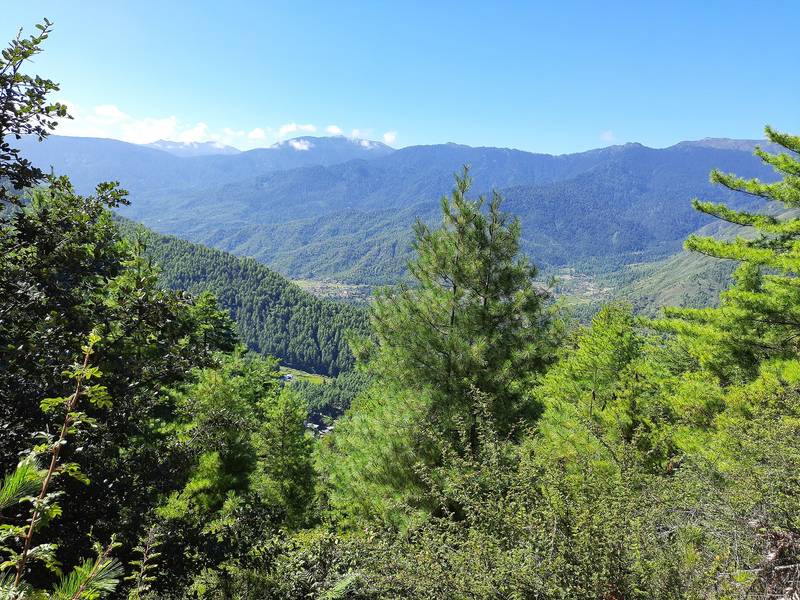
On a clear day, sit on the left flying in from Kathmandu or Delhi for the Himalaya.

Visa and fees
What every visitor pays
Everyone except Indian nationals needs a visa, and all visitors pay a Sustainable Development Fee (SDF) for each night in Bhutan. Our prices include both.
per person, per night.
per night. Children under 6 pay no SDF.
once per trip. We apply online for you.
on tour services. Not charged on the SDF or visa.
Guides are required
Trekkers must walk with a guide certified by Bhutan's Department of Tourism. You don't need separate route permits inside the country, and restricted trekking routes are open with a certified trekking guide.
Indian nationals pay an SDF of INR 1,200 per night and get an entry permit instead of a visa. Rules change; we check them for every booking.
When to go
Two seasons up high, winter down low
Spring (March to May) brings rhododendrons; autumn (late September to November) brings the clearest views. June to August is monsoon. In winter, the high passes close and the low Nabji–Korphu trail is at its best.
| Trek | Jan | Feb | Mar | Apr | May | Jun | Jul | Aug | Sep | Oct | Nov | Dec |
|---|---|---|---|---|---|---|---|---|---|---|---|---|
| Druk Path | – | – | Good | Good | Good | – | – | – | Good | Good | Good | – |
| Dagala Thousand Lakes | – | – | – | Good | Good | – | – | – | Good | Good | Good | – |
| Jomolhari | – | – | – | Good | Good | – | – | – | Good | Good | Good | – |
| Laya–Gasa | – | – | – | Good | Good | – | – | – | Good | Good | – | – |
| Snowman | – | – | – | Good | Good | – | – | – | Good | Good | – | – |
| Nabji–Korphu | Good | Good | Good | Good | – | – | – | – | – | Good | Good | Good |
| Merak–Sakteng | – | – | Good | Good | Good | – | – | – | Good | Good | Good | – |
In seasonClosed or not recommended
Altitude and fitness
Go up slowly, come down fast
Most of our treks sleep above 3,500 m, and the highest passes are above 5,000 m. Anyone can get altitude sickness, fit or not. What helps is time.
- Every itinerary starts with a day hike to about 4,000 m before the first night high.
- Above 3,000 m, our treks gain no more than about 500 m of sleeping height a day where the route allows, with rest days built in.
- Your guide checks how you feel and your blood oxygen every morning and evening.
- Above 4,500 m we carry a portable altitude chamber, and every trek has a satellite phone.
- If someone has real symptoms, we go down. No summit or pass is worth it.
Fitness matters too. Train for months, not weeks: long walks with hills, a day pack and the boots you'll wear.

What to bring
You carry a day pack. We carry the rest.
Ponies or yaks carry one duffel each (15 kg). We supply tents, mats, the kitchen and a duffel bag.
Bring:
- Broken-in waterproof boots with ankle support
- Trail shoes or sandals for camp and river crossings
- Four-season sleeping bag (or hire ours)
- Down jacket
- Waterproof jacket and trousers
- Fleece or warm mid-layer
- Two sets of trekking clothes, quick-drying
- Thermal base layers for nights
- Warm hat, sun hat, gloves
- Sunglasses (category 3 or 4)
- Sunscreen and lip balm, SPF 50
- Two 1-litre water bottles
- Day pack, 25 to 35 litres
- Trekking poles
- Head torch and spare batteries
- Personal first-aid kit and medicines
- Power bank (charging is rare on longer treks)
- Passport valid for six months, travel insurance details
Trekking responsibly
Leave the valleys as you found them
Nothing left behind
All rubbish comes back down with us, and toilet tents are dug and filled properly.
Animals first
Weight limits for every pony and yak, rest days for the herds, and horsemen paid by the day, not the load.
Money stays local
Crews, camps and homestays come from the villages on the route, and the SDF funds Bhutan's schools, health care and conservation.
Questions
Before you book
Can I trek in Bhutan without a tour operator?
No. Treks need a guide certified by the Department of Tourism, and in practice a licensed operator to arrange the crew, permits and camps.
Is travel insurance compulsory?
Not since April 2024, when Bhutan dropped it as a visa requirement. We still ask every trekker to have cover that includes helicopter evacuation.
What currency do I need?
The ngultrum (BTN), which is pegged to the Indian rupee. Your trek is paid in advance in US dollars; bring some cash for tips and shopping. Towns have ATMs.
Is there phone signal on trek?
On the Druk Path and Dagala, in places. On the longer treks, rarely. Your guide carries a satellite phone.
How fit do I need to be?
Fit enough to walk 6 hours a day, several days in a row, carrying a day pack. Each trek page says what to expect, and we're happy to talk it through.
Questions we haven't answered?
Ask us anything about Bhutan, the treks or the paperwork. A real person replies, usually the same day.